There are attractions you visit because they are on the list. IWM North is not one of those. Imperial War Museum North in Salford Quays is the kind of place that first-time visitors approach with mild curiosity and leave genuinely altered — having experienced something they were not expecting, in a building they were not prepared for, looking at a collection that made them think about things they had not previously considered in the particular way that a well-designed museum can make you think about things.
That is a large claim. It is also what visitors to IWM North say, consistently, in their own words when they describe the experience to other people afterwards. Not that it was educational, though it is. Not that it was informative, though it is. But that it was genuinely moving in a way that free attractions — free attractions in a former industrial area of Greater Manchester, specifically — are not supposed to be.
This guide covers what the visit actually involves, what the experience is genuinely like from arrival to departure, how long to allow, and how to get there comfortably from Cornerstones Guest House in Sale. It also covers how to turn a single IWM North visit into a full and deeply rewarding Salford Quays day — because the waterfront that surrounds the museum contains more genuine cultural richness per square metre than almost any comparable area in the north of England.
The Building — Before You Even Go Inside
The first thing that happens at IWM North is not inside the museum. It happens on the approach — on Trafford Wharf Road, walking from the Metrolink tram stop or the car park along the waterside path towards the building. You look up and you see something that does not look like a museum.
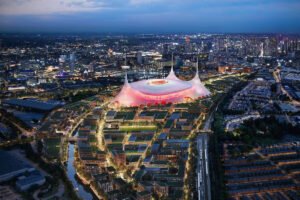
Daniel Libeskind designed IWM North in the late 1990s and it opened in 2002. The building is constructed from three interlocking shards — shapes that Libeskind described as representing the three environments in which modern conflict takes place. The Earth Shard is the main curved structure that houses the primary gallery space. The Water Shard is a lower structure that serves as an event space. The Air Shard is the tall angular tower — the most immediately recognisable element of the building from a distance — that serves as the entrance and houses a viewing platform.
The shards appear to lean into each other at uncomfortable angles. The surfaces are clad in aluminium that catches and reflects the light differently depending on the time of day and the weather — which in Manchester means they are never quite the same twice. The building sits on the bank of the Manchester Ship Canal at the western edge of Salford Quays, directly opposite MediaCityUK and The Lowry, and the combination of its extraordinary form reflected in the canal water and the striking contemporary architecture of its neighbours creates one of the most genuinely interesting waterfront architectural compositions in England.
Architecture enthusiasts will want to walk the full perimeter of the building before going inside. Everyone else will still find themselves stopping to look at it from multiple angles, wondering exactly how it stays up, and taking photographs of the reflections in the water. Allow ten minutes for this before you enter. It is worth it.
Once you cross the threshold into the Air Shard entrance, the building immediately does something else. The floors slope. Not dramatically — not enough to make you stumble — but enough to make you aware of it. The ceilings angle in directions that do not feel quite vertical. The spatial relationships are subtly wrong in ways that are disorienting without being alarming. This is intentional. Libeskind designed the interior as a physical metaphor for the disruptive, disorientating nature of conflict — the sense of a world in which the normal rules of space and stability no longer apply. You do not need to be told this for it to work. You feel it.
The Big Picture Show — Allow Time for This Specifically
The Big Picture Show is the experience at IWM North that visitors talk about most consistently when they describe what IWM North is actually like to someone who has not been. It is also the experience that is most difficult to describe in a way that captures what it is actually like — which is a fair indicator that it is worth experiencing rather than simply reading about.
The Big Picture Show takes place in the Earth Shard — the main gallery space, a large curved room with a dramatically arching ceiling and floor space that can accommodate a substantial number of visitors at once. At approximately hourly or half-hourly intervals throughout the day, the lighting in the gallery dims and a 360-degree immersive film begins projecting across every surface of the curved interior walls and ceiling simultaneously. The projections cover the complete curved interior of the gallery space — floor, walls, ceiling — creating an immersive environment that surrounds visitors entirely with imagery, sound, and light.
Each Big Picture Show programme runs for approximately ten minutes and covers a specific theme related to conflict and its impact on people — personal testimonies, archival footage, documentary material, and artistic imagery combined into a programme that uses the extraordinary projection environment of the Earth Shard gallery to create a cumulative emotional effect that a flat screen in a conventional gallery space could not achieve. The programmes rotate — so if you visit more than once across different months, the specific content may differ, though the format and the emotional impact are consistent.
What the Big Picture Show feels like is something close to being inside a piece of film rather than watching it. The scale, the 360-degree wrap of imagery and sound, and the subject matter — conflict, loss, memory, the impact of war on ordinary people in extraordinary circumstances — combine to create a ten-minute experience that many visitors describe as the most powerful single moment of their visit, and some describe as the most powerful ten minutes of any free cultural experience they have had in England.
Check the schedule for Big Picture Show times when you arrive at the museum. The shows run throughout the day but not continuously — arriving without checking the timetable and missing the next show by ten minutes, then leaving before the following one runs, is the one genuinely avoidable disappointment that some visitors experience at IWM North. Ask at the welcome desk on arrival when the next show runs. Plan the rest of your visit around it. Do not leave before you have seen it.
The Permanent Collection — People, Not Machinery
The permanent galleries at IWM North run chronologically from the First World War through to the most recent conflicts of the 21st century, covering themes that include the two World Wars, the Cold War, conflicts in Korea, Vietnam, the Falklands, the Gulf, Bosnia, Afghanistan, and Iraq. The collection is large enough to reward a genuinely extended visit and focused enough in its curatorial approach that it never feels exhausting or overwhelming.
The specific character of the IWM North collection — and what distinguishes it from a simple military museum of the kind that displays hardware and equipment in glass cases — is its consistent and deliberate focus on the human experience of conflict rather than its technical or tactical dimensions. The collection is full of objects, but they are objects that belong to specific people in specific circumstances — the letters, the uniforms, the personal photographs, the domestic items that found their way into war zones and came back changed by what they witnessed.
This human focus makes the collection particularly powerful for visitors who have personal or family connections to any of the conflicts covered. The First and Second World War galleries are the most consistently moving for this reason — the generation of visitors who knew people who served in these conflicts is ageing, but the specific objects and personal testimonies in the collection create a bridge between historical documentation and individual human experience that transcends generational distance.
Families visiting with children of secondary school age will find the collection engages well with the kinds of historical material that appears in the national curriculum — particularly for the First and Second World Wars, the Cold War, and more recent conflicts. The museum’s approach to difficult and sometimes harrowing material is thoughtful and appropriate for a wide age range, though parents of younger children should be aware that some elements of the collection deal with the realities of conflict in ways that may require discussion and context. The museum staff are experienced in supporting visitors of all ages with this.
The Air Shard Viewing Platform
The Air Shard — the tall angular tower element of the building that forms the entrance — contains a viewing platform accessible by lift from the ground floor. The platform sits high enough above the Salford Quays waterfront to provide genuinely panoramic views across the Manchester Ship Canal, MediaCityUK, The Lowry, and the Manchester city centre skyline in the middle distance.
The viewing platform is free to access as part of the museum visit and adds no additional time commitment beyond the lift journey and a few minutes taking in the panorama. It is particularly rewarding on clear days when the Manchester skyline is visible at full extent — the combination of the waterfront immediately below, the architectural drama of the surrounding Salford Quays development, and the city centre on the horizon provides one of the most distinctive free views available in the Manchester area. On overcast days, which are more common in Greater Manchester than clear ones, the views are less dramatic but still worth the ride up.
Practical Information — Opening Times, Free Entry, and How Long to Allow
IWM North is open seven days a week throughout the year. Opening times are typically 10am to 5pm daily, with the last admission at 4:30pm. Entry is completely free for all visitors at all times, with no booking requirement for general admission. Some special exhibitions and specific events may carry a charge — check the IWM North website at iwm.org.uk for the current programme before visiting.
The museum is fully wheelchair accessible throughout, with lift access to all levels including the Air Shard viewing platform. Accessible toilets are available on the ground floor. Pushchair access is straightforward throughout the building. Assistance dogs are welcome. Hearing loops are available in the main gallery spaces.
The IWM North café is located on the ground floor and serves hot and cold food and drinks throughout the museum’s opening hours. It provides a practical refreshment stop mid-visit without requiring visitors to leave the building, and the seating area overlooks the canal waterfront through full-height windows — making it a genuinely pleasant place to pause rather than merely a functional catering facility.
For how long to allow — the minimum that makes the Big Picture Show, a walk through the main galleries, and the Air Shard platform realistic is 90 minutes. Most visitors who engage with the collection properly rather than moving quickly through it will spend between two and three hours in the museum. For visitors with a strong interest in the history covered by the collection, a full morning or afternoon is not an unreasonable allocation.
Getting to IWM North From Sale — Tram, Car, or Both
From Cornerstones Guest House on Washway Road in Sale, IWM North at Salford Quays is accessible by both Metrolink tram and by car — and for most visitors arriving without specific time pressure, the tram is the more comfortable and more enjoyable option.
By Metrolink tram from Sale, the journey takes approximately 15 to 20 minutes. Take the tram from Sale Metrolink station or Brooklands station towards Manchester city centre. At Cornbrook junction — the interchange stop where the Sale and Altrincham line meets the Eccles and MediaCityUK branches — change to the tram service towards MediaCityUK. The MediaCityUK tram stop is the closest to IWM North, sitting at the heart of the Salford Quays complex on the opposite bank of the dock from The Lowry. From MediaCityUK tram stop, IWM North is approximately a 5-minute walk following the signage along Trafford Wharf Road.
The Cornbrook interchange is the key junction to understand for this journey. It is not the same as travelling all the way into Manchester city centre and changing there — the Cornbrook junction allows the change from the Sale line to the MediaCityUK line without entering the city centre at all, which is why the journey time from Sale to IWM North is faster than many visitors initially expect. The Bee Network app at tfgm.com provides real-time journey planning and timetables for the specific connection.
By car from Sale, IWM North is approximately 20 to 25 minutes via the A56 Chester Road heading north and then the A5063 to Trafford Wharf Road. Car parking is available at the museum site on Trafford Wharf Road — the IWM North car park is adjacent to the museum building and is charged at standard rates. Free on-site parking at Cornerstones Guest House covers the Washway Road end of the journey — so car-driving visitors pay for the IWM North parking only, not for accommodation parking as well.
The tram is generally the more practical option for IWM North visits specifically because the Salford Quays waterfront is best explored on foot — and arriving by tram at MediaCityUK means you are already on the waterfront, ready to walk between IWM North, The Lowry, and the wider quayside without needing to think about parking or retrieval. If your day at Salford Quays involves multiple venues and a waterfront walk, arriving by tram and returning by tram is the arrangement that makes the day most seamless.
Making a Full Day of Salford Quays From Sale
IWM North is powerful enough to justify a half-day visit on its own — but the waterfront it sits on contains enough of genuine interest to turn a half-day into a full and deeply rewarding day without any sense of padding or itinerary-filling.
The Lowry Theatre and Gallery is a five-minute walk across the Lowry Bridge footbridge from IWM North. The Lowry’s permanent gallery of L.S. Lowry paintings and drawings is free to visit and provides an extraordinary and specific perspective on the industrial landscape of Greater Manchester that IWM North’s own collection contextualises in a different way. L.S. Lowry painted the mills, the streets, and the people of Salford and the surrounding area throughout the first half of the twentieth century — the period during which many of the conflicts covered by IWM North’s collection were taking place. Visiting the two collections in the same day creates a resonance between them that neither collection produces on its own.
The Salford Quays waterfront walk itself — from IWM North westward along Trafford Wharf Road and then north across the Lowry Bridge and around the MediaCityUK basin back to the tram stop — is approximately two miles of flat, well-surfaced, accessible waterside walking through one of the most architecturally and historically layered urban waterfront environments in England. The combination of the Manchester Ship Canal, the former dockland warehouses that have been converted into residential and commercial uses, the contemporary architecture of MediaCityUK, and the striking forms of IWM North and The Lowry creates a walking environment that is genuinely interesting to move through rather than merely functional.
MediaCityUK itself — the BBC and ITV production campus immediately adjacent to the Salford Quays waterfront — adds a further dimension for visitors interested in British broadcasting and television history. The Coronation Street tour, which allows visitors to walk the most famous street in British television history, operates from MediaCityUK and requires advance booking but is consistently one of the most talked-about paid visitor experiences in the whole of Greater Manchester.
A complete Salford Quays day from Sale — arriving by tram at MediaCityUK at 10am, spending a morning at IWM North including the Big Picture Show, lunch at the museum café or at one of the MediaCityUK waterside restaurants, an afternoon at The Lowry gallery followed by the waterfront walk, and returning to Sale by tram in time for dinner at one of Sale’s excellent independent restaurants — is one of the most genuinely satisfying and culturally rich free days available to anyone staying in Greater Manchester. The fact that everything except lunch and dinner costs nothing makes it one of the most accessible as well.
Booking Your Stay in Sale for a Salford Quays Visit
Guests at Cornerstones Guest House on Washway Road in Sale are 15 to 20 minutes by Metrolink tram from IWM North at Salford Quays — close enough that a morning at the museum, an afternoon at The Lowry, and an evening back in Sale for dinner at Mangiando Calabro or Rudy’s Neapolitan Pizza is a completely natural and unstressed day from a Sale base.
The combination of free on-site parking at the guest house, the direct Metrolink connection to Salford Quays via Cornbrook, and the quality of Sale’s own restaurant scene for the evening means that a Salford Quays visit from Cornerstones is as close to an ideal day-trip arrangement as any comparable base in Greater Manchester offers.
To book your stay, contact us directly:
Online booking: oyorooms.com/gb/325939