One of the things that surprises guests at Cornerstones Guest House most consistently — particularly guests who chose Sale over Manchester city centre primarily because of the tram connection into the city — is how much outstanding free outdoor walking there is within reach of Washway Road before the tram enters into the picture at all.
The Bridgewater Canal towpath begins within a five-minute walk of the guest house front door. Sale Water Park — a nature reserve and Site of Special Scientific Interest designated for its outstanding wildlife habitat — is reachable on foot from the canal towpath without crossing a single road. The combined morning walk that takes in both the canal and the water park, starting and ending at Cornerstones Guest House on Washway Road, covers approximately three miles of completely flat, completely traffic-free, genuinely beautiful countryside walking in an urban area — and it costs nothing.
This is not the walk that appears in Manchester city guide books. It is the walk that Sale residents do on Sunday mornings, that the birdwatching community knows about in specific and passionate detail, and that Cornerstones guests who discover it during their stay consistently describe as one of the most unexpected and genuinely pleasurable parts of the whole visit.
This guide covers everything you need to get the most from both destinations — the canal towpath in both directions from Sale, the water park circular route, the wildlife to look for at different times of year, the practical details about parking and access, and the combined half-day route that turns the two into a single seamless morning of proper outdoor walking from your front door.
The Bridgewater Canal — Starting From Washway Road
The Bridgewater Canal is one of the most historically significant waterways in England. Completed in 1761 by the Duke of Bridgewater to carry coal from his mines in Worsley to Manchester, it was the first commercially successful artificial canal in England and is widely credited with helping trigger the Industrial Revolution that transformed Manchester, Greater Manchester, and the entire economic geography of the north of England. The canal is 39 miles long in total, running from Castlefield in Manchester city centre west through Sale and Altrincham to Runcorn on the Mersey Estuary.
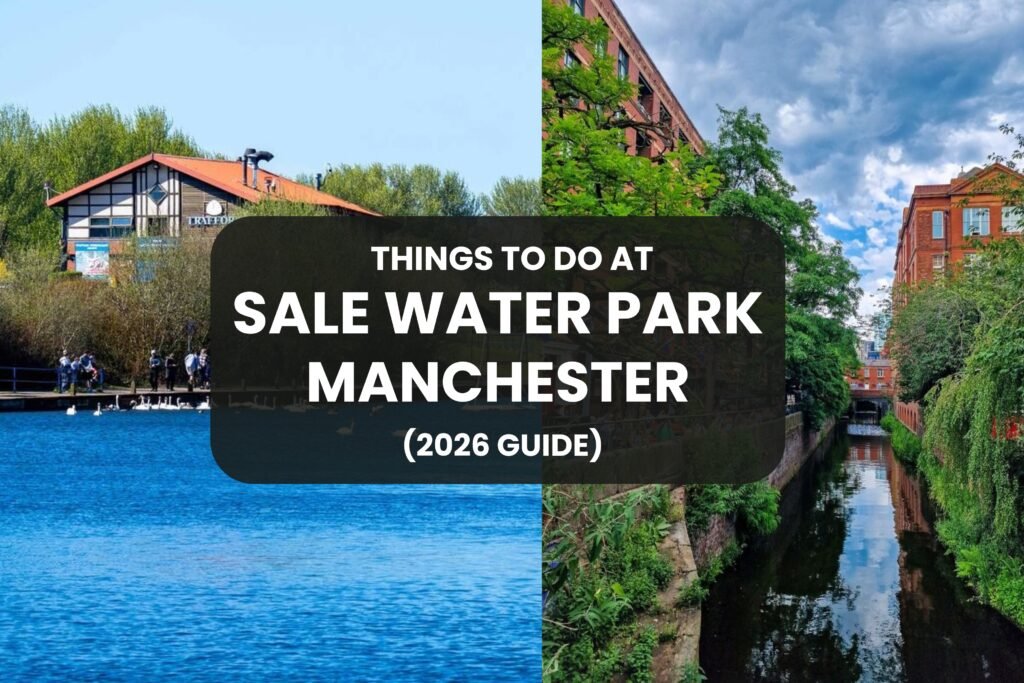
The towpath that runs alongside the canal throughout its length is now maintained as a recreational walking and cycling route — flat, well-surfaced on most sections, and completely traffic-free from one end to the other. For guests at Cornerstones Guest House, the canal towpath is accessible within approximately five minutes’ walk of the guest house on Washway Road. Head north-west from the guest house towards the A56 Chester Road junction, then find the canal access point that drops down to the towpath.
Once on the towpath, two directions are available and both reward exploration.
East Along the Canal — Towards Manchester City Centre and Castlefield
Heading east from Sale, the Bridgewater Canal towpath follows the waterway towards Stretford, Cornbrook, and ultimately Castlefield in Manchester city centre — a one-way distance of approximately eight miles. The route passes through a genuinely varied sequence of landscapes that reflects Greater Manchester’s layered history — residential canal corridors in Stretford where the Victorian terraces back directly onto the water, industrial remnants of the canal’s commercial past in narrowboat maintenance yards and former warehouses, and the extraordinary arrival at Castlefield where the canal meets the Roman fort remains, Victorian railway arches, and restored canal basin that make it one of the most atmospheric free outdoor spaces in Manchester.
The full walk from Sale to Castlefield is a substantial morning or afternoon commitment — allow three to four hours at a comfortable walking pace for the one-way journey. Many guests choose to walk a section of this route — an hour east along the canal and an hour back — rather than completing the full distance, which provides a genuine sense of the canal corridor without committing to a full-day walk. Taking the Metrolink tram back from the city centre to Sale after completing the full one-way walk is the most practical return route for those who want to walk the complete distance without retracing their steps.
The canal itself is busy with narrowboats throughout the warmer months — watching the working and leisure narrowboats navigate the towpath sections, passing through the canal bridges, and moving through the occasional lock is one of the quiet pleasures of this walk that makes it more interesting than a simple linear path through urban surroundings.
West Along the Canal — Towards Altrincham and the Cheshire Countryside
Heading west from the Sale access point, the Bridgewater Canal towpath follows the waterway south towards Altrincham — approximately three miles to the Altrincham canal bridge — and continues into the Cheshire countryside towards Dunham Massey, one of the National Trust’s most visited and most beautiful properties in the north of England.
The walk west from Sale to Altrincham along the canal towpath takes approximately one hour at a comfortable walking pace and provides a genuinely pleasant and varied corridor through the residential and parkland areas of south Sale and north Altrincham. This section of the canal is particularly popular with cyclists as well as walkers — the flat, well-surfaced towpath makes it accessible for leisure cycling with children as well as more purposeful riding.
Continuing past Altrincham on the westward towpath, the canal enters a more rural character as it approaches Dunham Massey Park — the National Trust deer park estate that is one of the most beautiful and most accessible free outdoor spaces in Cheshire. The canal towpath passes along the northern edge of the Dunham Massey estate and the combination of the canal, the estate woodlands, and the regular sightings of fallow deer from the towpath makes this section one of the most rewarding of the entire Bridgewater Canal route from Sale. Allow approximately two hours each way for the Sale to Dunham Massey section and back.
Sale Water Park — What It Is and Why It Matters
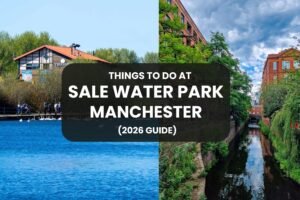
Sale Water Park is a nature reserve and Site of Special Scientific Interest located on the River Mersey floodplain approximately one mile south-east of Sale town centre. The park covers approximately 224 acres of managed nature reserve habitat including the main lake, reed beds, willow woodland, meadow grassland, and the wider Mersey floodplain corridor that connects to Chorlton Water Park to the north and Sale Ees and Broad Ees Dole nature reserves to the east.
The lake at the heart of Sale Water Park was created by a process that is specific to the south Manchester area — subsidence from historic underground salt mining that caused the land surface to sink, gradually filling with groundwater to create a substantial open water body. The resulting lake is not a purpose-built recreational reservoir but a genuinely wild water body of the kind that develops its own complex ecology over decades — and the specific ecology of Sale Water Park, designated as a Site of Special Scientific Interest for its wintering wildfowl and breeding bird populations, is one of the most rewarding birdwatching sites accessible to Manchester visitors.
The park is open all year, dawn to dusk, with free entry throughout. Free car parking is available at the main car park off Rifle Road — approximately five minutes by car from Cornerstones Guest House on Washway Road. The park is also accessible on foot from the guest house via the Bridgewater Canal towpath and the River Mersey floodplain paths — a route that takes approximately 30 to 40 minutes each way and forms the basis of the combined half-day walking route described later in this guide.
The Sale Water Park Circular Walk
The main circular walking route around Sale Water Park follows the lake perimeter and the wider nature reserve paths in a loop of approximately two to three miles — completely flat, largely well-surfaced, and accessible throughout the year with appropriate footwear. The route takes approximately 60 to 90 minutes at a gentle walking pace and provides a genuinely varied sequence of habitats and views that makes it one of the most rewarding free short walks available within the Greater Manchester boundary.
Starting from the main car park on Rifle Road, the path follows the eastern shore of the lake northward — opening almost immediately onto views across the open water towards the reed beds on the western shore. This eastern section of the lake provides the best views across the main open water body and is where the highest concentrations of wildfowl are typically visible, particularly during autumn and winter when migrant and wintering species augment the resident breeding population.
The northern end of the lake connects to the River Mersey floodplain paths — a network of flat, grassland walking routes through the meadow habitats that form the wider Mersey Valley corridor between Sale and Chorlton Water Park to the north. The floodplain paths provide a different character from the lakeside walking — more open, more exposed to the weather, and with the wide, slow-moving River Mersey visible through the bankside vegetation in the wetter seasons. The combination of lake, reed bed, floodplain meadow, and riverside woodland that this northern section provides makes it the most ecologically diverse section of the circular route.
The western shore of the lake passes through the reed bed margins — the dense stands of common reed that provide nesting habitat for reed warblers and reed buntings in spring and summer, and roosting habitat for large numbers of swallows and sand martins during the autumn migration. The path here is sometimes narrower and can be muddy after prolonged wet weather — walking boots or waterproof footwear is recommended for this section in autumn and winter.
The southern end of the circular route returns to the car park via the meadow grassland areas that are managed specifically for wildflowers and invertebrates — and that, in May and June, provide some of the most colourful and most enjoyable grassland walking available anywhere in the Mersey Valley corridor.
Wildlife at Sale Water Park — What to Look For and When
Sale Water Park is genuinely one of the most rewarding birdwatching sites accessible to visitors staying in Sale Manchester, and the seasonal variation in what can be seen makes multiple visits at different times of year consistently worthwhile.
Spring — March to May
Spring at Sale Water Park brings the return of the breeding season and the arrival of summer migrant species. The great crested grebe is the most spectacular of the resident breeding birds — a large, elaborately decorated waterbird that performs an extraordinary courtship display on the open water in early spring, facing its mate and rising upright out of the water in synchronised movements that are genuinely remarkable to observe at close range. Great crested grebes are present throughout the year but most visible and most active in their breeding behaviour from February through April.
The reed beds along the western shore begin calling in late April when the reed warblers return from their African wintering grounds — the insistent, mechanical churring song of the reed warbler filling the reed bed margins from dawn onwards. Sedge warblers, grasshopper warblers, and whitethroats all use the scrub and grassland habitats around the park in spring.
The main lake holds breeding little grebe, tufted duck, and great crested grebe in spring — and the shallow margins attract grey heron throughout the year, standing motionless at the water’s edge with the specific quality of patient attention that herons have and that makes watching them strangely restful.
Summer — June to August
Summer at Sale Water Park is the season of swifts, swallows, and house martins hunting insects over the open water — the aerial feeding displays of these species over a large open water body on a warm summer evening being one of the most effortless and most enjoyable pieces of wildlife observation available in the Manchester area. Kingfisher sightings along the lake margins and the connecting river channels are most frequent in summer when the water levels are stable and clear enough for effective hunting — a flash of iridescent blue and orange along the reed bed edge is the specific Sale Water Park wildlife moment that guests who see it remember and talk about most.
Autumn — September to November
Autumn brings the peak migration season and the arrival of the first winter visitors. The open water fills with increasing numbers of wildfowl from September onwards as birds from northern and eastern Europe arrive for the winter. Pochard, goldeneye, goosander, and occasionally rarer diving ducks use the main lake during autumn and winter. The grassland areas attract fieldfares and redwings — large northern thrushes that arrive from Scandinavia and Iceland in October — feeding on the autumn berry crop in the hedgerows around the park perimeter.
This is the best season for birdwatching in terms of overall species diversity and the sheer number of birds using the site — and the low autumn light over the open water in the morning and late afternoon provides the most atmospheric conditions for watching wildfowl on the lake.
Winter — December to February
Winter concentrates the wildfowl numbers further and brings the possibility of short-eared owls hunting over the Mersey floodplain grasslands in late afternoon light — one of the most dramatic and most sought-after wildlife sightings available anywhere in the Greater Manchester area. Short-eared owls are not guaranteed — they are mobile and their presence depends on vole populations and weather conditions — but the Sale Water Park and Mersey Valley corridor is one of the most reliable locations in Greater Manchester for encountering them in a good winter.
The main lake in winter holds large concentrations of common wildfowl including tufted duck, pochard, wigeon, teal, and mallard — often in considerable numbers that make the walk around the lake perimeter genuinely impressive even for visitors with limited birdwatching knowledge. Water rails call from the reed beds throughout winter — their extraordinary pig-like squealing call emerging from apparently impenetrable reed beds is one of the most surprising and most memorable wildlife sounds associated with Sale Water Park in the colder months.
The Combined Route — Bridgewater Canal and Sale Water Park From Cornerstones
The following half-day route combines the Bridgewater Canal towpath with the Sale Water Park circular walk in a single continuous loop from Cornerstones Guest House on Washway Road — approximately three miles in total, completely flat, traffic-free for almost the entire distance, and taking between two and three hours at a comfortable walking pace.
Start at Cornerstones Guest House on Washway Road. Walk north-west along Washway Road towards the A56 junction, then drop down to the Bridgewater Canal towpath. Turn left — east — on the towpath and follow the canal briefly before taking the connecting path south towards the River Mersey floodplain. The path connects the canal corridor to the Mersey Valley walking network via a series of well-maintained public footpaths through the Sale Ees nature reserve — an area of wet woodland, grassland, and riverside habitat that forms the transitional zone between the canal and the water park.
Follow the Mersey Valley paths south and east until the main Sale Water Park lake comes into view on the left. Walk the eastern shore of the lake in a clockwise direction — the full circular route described above — taking in the reed beds, the open water views, the floodplain meadow section at the northern end, and the willow woodland along the western shore before returning to the southern car park area.
From Sale Water Park, follow the Rifle Road path north and connect back to the Bridgewater Canal towpath via the Sale Moor residential streets. Return west along the canal towpath to the Washway Road access point and back to Cornerstones Guest House on Washway Road — the full circular loop completed without retracing any significant section of the outward route.
The entire route is navigable with an Ordnance Survey map of the area, on the OS Maps app, or using the walking route data available through the Greater Manchester Natural Environment team’s website. The route is flat and accessible throughout — suitable for walkers of all abilities in reasonable footwear, with the caveat that the reed bed section of the water park circular can be muddy after rain and benefits from waterproof boots in autumn and winter.
Practical Information — Footwear, Timing, and Refreshments
Footwear for the combined route depends on the season. In spring and summer, comfortable trainers or walking shoes are sufficient for most of the route with the exception of the reed bed margins which can hold water after rain. In autumn and winter, waterproof walking boots are strongly recommended for the Sale Water Park sections — the floodplain paths can be genuinely wet in wetter periods and the reed bed margins in particular hold surface water long after rainfall has stopped.
For the Bridgewater Canal towpath sections, the hard-surfaced towpath is walkable in any footwear throughout the year — making the canal walk accessible even for guests who have not packed specifically for outdoor walking.
The best time of day for the combined route in terms of wildlife interest is the early morning — from approximately 7am to 9am in summer and 8am to 10am in winter — when bird activity is at its highest and the light on the open water is at its most atmospheric. For guests staying at Cornerstones Guest House who want to complete the walk before heading into Manchester city centre by tram for a day of cultural activities, an early morning start allows the full combined route to be completed and breakfast to be taken at Blanchflower on Stanley Square before the day’s main activities begin.
Refreshment options near Sale Water Park include the Waterside Arts Centre café adjacent to the park on Sale Waterside — a well-regarded café and arts venue that provides a natural and pleasant stopping point at the northern end of the water park before or after the circular walk. Sale town centre with its full range of cafés and restaurants including Blanchflower on Stanley Square, Canteena, and the wider Stanley Square independent food offer is a short walk from the canal towpath return route to Cornerstones Guest House.
For guests who want to extend the Bridgewater Canal section of the walk west towards Altrincham and Dunham Massey, Altrincham Market House on the days it is open — Thursday to Sunday — provides an exceptional refreshment and food stop at the end of the westward canal walk, with the Metrolink tram from Altrincham back to Sale offering an easy return to Cornerstones Guest House for guests who have walked one way and want to tram back.
Before You Head Out
The walks described in this guide are all accessible directly from Cornerstones Guest House on Washway Road — no car required, no additional transport cost, and no planning beyond appropriate footwear and a sense of which direction you want to walk first.
For guests combining the Sale Water Park and Bridgewater Canal walks with a wider Manchester visiting programme — the Explore Manchester section of our website covers the full range of Greater Manchester attractions accessible from Sale by tram and car, including Tatton Park in Knutsford for a Cheshire countryside alternative, the Salford Quays waterfront walk for urban waterside walking in a completely different architectural environment, and the full range of walks near Manchester accessible from a Sale base.
To book your stay at Cornerstones Guest House and start planning your walks:
Online booking: oyorooms.com/gb/325939